Guide · Visas
Vietnam business visa: DN1, DN2 and labour visas.
Which Vietnam visa a business visitor or a foreign employee needs — DN1, DN2, LĐ1, LĐ2 or an e-visa — with terms, government fees, how to switch to a labour visa, and Nhân Kiệt’s US$250 fee for a business visa.
Updated 12 November 2026 · By Nguyễn Quốc Trung, Deputy General Director of Nhân Kiệt · Checked by Nhân Kiệt's payroll and employment-law team (labour leasing licence 029/LĐTBXH-GP, employing people in Vietnam since 2009) · About 6 min read · General information, not legal or tax advice
Short answer
What is a Vietnam business visa?
A Vietnam business visa is a visa sponsored by a Vietnamese company for a foreign national who comes to meet, negotiate or work with it: code DN1 for working with a Vietnamese company, DN2 for offering services or setting up a commercial presence. It lasts up to 12 months, is approved by the Immigration Department within 5 working days of the sponsor’s request, and costs a government fee of US$25 to US$135 depending on entries and term. A business visa does not allow employment: a foreign employee needs a work permit and a labour visa (LĐ2), up to 2 years, followed by a temporary residence card. Short trips can use an e-visa of up to 90 days. Nhân Kiệt files a business visa for your Vietnamese entity for US$250, government fee included, plus VAT.
Key takeaways: Vietnam business and labour visas
- DN1 and DN2 business visas last up to 12 months and need a Vietnamese company as sponsor.
- The Immigration Department approves a sponsor’s request within 5 working days.
- Government fees run from US$25 for a single entry to US$135 for multiple entries over 6–12 months.
- Working in Vietnam needs a work permit and an LĐ visa of up to 2 years, not a DN visa.
- Nhân Kiệt’s fee for a business visa is US$250, government fee included, plus VAT.
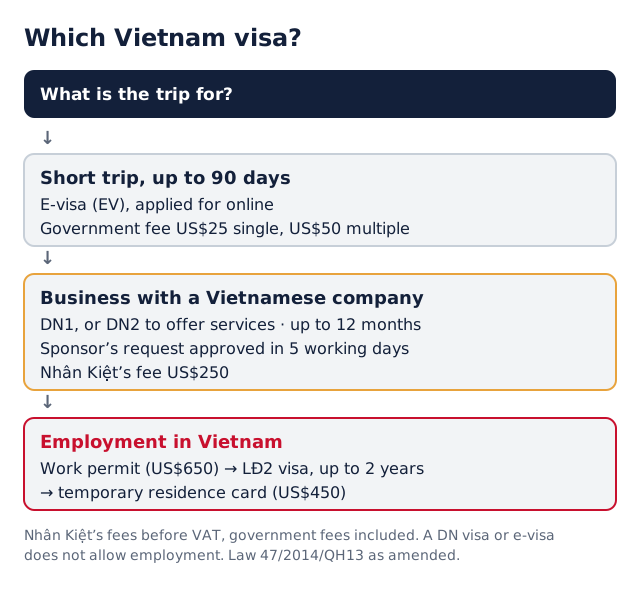
Published 12 November 2026: visa codes for business and work, terms and government fees, how to switch to a labour visa, and Nhân Kiệt’s fees, with a decision diagram.
Visa codes
Which Vietnam visa does a business visitor or employee need?
The Vietnam visa a foreign national needs depends on the purpose of the trip: DN1 or DN2 to do business with a Vietnamese company, LĐ1 or LĐ2 to work for one, or an e-visa for a short trip. Article 8 of Law 47/2014/QH13, as amended, sets the codes, and Article 9 sets the terms.
| Visa code | Purpose | Longest term |
|---|---|---|
| DN1 | Working with a Vietnamese company or organisation: meetings, negotiations, inspections | 12 months |
| DN2 | Offering services, setting up a commercial presence or other activities under a treaty | 12 months |
| LĐ1 | Working with a confirmed work-permit exemption | 2 years |
| LĐ2 | Working with a work permit | 2 years |
| EV | E-visa for any short purpose, applied for online by the traveller | 90 days |
Source: Law 47/2014/QH13 on the entry, exit, transit and residence of foreigners in Vietnam, as amended by Law 51/2019/QH14 and Law 23/2023/QH15 (e-visas up to 90 days from 15 August 2023).
How to apply
How do you get a Vietnam business visa?
A Vietnam business visa is obtained in three steps: the Vietnamese sponsor files a request (form NA2) with the Immigration Department, the department approves it within 5 working days, and the visitor collects the visa at a Vietnamese embassy or on arrival at an international airport.
| Step | What happens | Who |
|---|---|---|
| 1. Sponsor registration | First-time sponsors register their seal and signatory (form NA16) | Vietnamese company |
| 2. Visa request | Form NA2 with the visitor’s passport details, purpose and dates | Vietnamese company |
| 3. Approval | Approval letter within 5 working days | Immigration Department |
| 4. Visa issued | At an embassy or consulate, or on arrival at an international airport | Visitor |
Cost
How much does a Vietnam business visa cost?
A Vietnam business visa costs a government fee of US$25 for a single entry and US$50 to US$135 for multiple entries, by term, under Circular 25/2021/TT-BTC as amended. Nhân Kiệt files a business visa for your entity for US$250, government fee included, plus VAT.
| Visa | Entries | Government fee |
|---|---|---|
| Any term | Single entry | US$25 |
| Up to 90 days | Multiple | US$50 |
| Over 90 to 180 days | Multiple | US$95 |
| Over 180 days to 1 year | Multiple | US$135 |
| Over 1 to 2 years (LĐ visas) | Multiple | US$145 |
| Service | What it covers | Fee |
|---|---|---|
| Business visa | NA2 request, approval letter and entry instructions | US$250 |
| Work permit | Category advice, dossier check, filing and collection | US$650 |
| Temporary residence card | Filing after the work permit, up to 2 years | US$450 |
Worked example: a foreign manager enters on a business visa, then starts work with a permit and a residence card. The one-off cost is US$250 + US$650 + US$450 = US$1,350 before VAT. Payroll and HR for that manager under a PEO then costs US$35 a month.
To get a quote, send the visitor’s nationality, the purpose and dates of the trip and your company’s province through the quote form or on WhatsApp or Zalo at +84 908 636 108.
Business or labour visa
Can you work in Vietnam on a business visa?
No. A Vietnam business visa (DN1 or DN2) allows meetings and business with a Vietnamese company, but not employment. Working needs a work permit and a labour visa (LĐ2). A visitor who entered on a DN visa or an e-visa can switch to an LĐ visa inside Vietnam once the work permit is issued, under Article 7 of Law 47/2014/QH13 as amended by Law 51/2019/QH14.
| Point | Business visa (DN1, DN2) | Labour visa (LĐ1, LĐ2) |
|---|---|---|
| Allows employment | No | Yes |
| Needs a work permit | No | LĐ2 yes; LĐ1 needs an exemption |
| Longest term | 12 months | 2 years |
| Leads to a residence card | No | Yes |
| Sponsor | The company the visitor does business with | The employer named on the work permit |
Common mistakes
Which Vietnam business visa mistakes cause problems?
These are the mistakes Nhân Kiệt sees most often when companies get a business or labour visa for a foreign national in Vietnam:
| Mistake | Consequence | Check |
|---|---|---|
| Working on a DN visa or e-visa | Fines for the employee and employer, possible deportation | Work permit and LĐ visa before day one |
| Purpose on the visa differs from the trip | Entry refused or visa cancelled | DN1 for business with your company, DN2 for services |
| Passport valid less than 6 months | Visa not issued | Passport valid 6 months beyond the trip |
| Overstaying the visa | Fines and exit delays | Track the visa end date, not the entry stamp |
| Expecting a residence card on a DN visa | Not eligible | Work permit, then LĐ2 visa, then card |
Card rules are in the Vietnam temporary residence card guide.
Questions
Vietnam business visa: frequently asked questions
What is the difference between a DN1 and a DN2 visa in Vietnam?
DN1 is for working with a Vietnamese company, such as meetings and negotiations. DN2 is for offering services or setting up a commercial presence under a treaty.
How long is a Vietnam business visa valid?
Up to 12 months for DN1 and DN2, single or multiple entry, as approved by the Immigration Department.
How much does a Vietnam business visa cost?
The government fee is US$25 for a single entry and US$50 to US$135 for multiple entries. Nhân Kiệt’s fee is US$250, government fee included, plus VAT.
How long does a Vietnam business visa take?
The Immigration Department approves the sponsor’s request within 5 working days; the visa is then issued at an embassy or on arrival.
Who can sponsor a Vietnam business visa?
A company or organisation with legal status in Vietnam that the visitor works with, after registering its seal and signatory with the immigration authority.
Can I work in Vietnam on a business visa?
No. Employment needs a work permit and an LĐ2 labour visa, or an LĐ1 visa with a confirmed exemption.
Can a DN1 visa be changed to a labour visa in Vietnam?
Yes, once the sponsoring company has obtained the work permit or exemption, the visa purpose can be converted to LĐ inside Vietnam.
Can a DN1 visa holder get a temporary residence card in Vietnam?
No. DN1 and DN2 visas do not qualify for a card; an employee needs a work permit and an LĐ visa first.
Is a Vietnam e-visa enough for a business trip?
For a short trip, yes: an e-visa lasts up to 90 days, single or multiple entry, for US$25 or US$50. It does not allow employment.
How long is a Vietnam labour visa valid?
Up to 2 years for LĐ1 and LĐ2, within the work permit or exemption term. A temporary residence card usually replaces it.
Sources
Sources and review.
This guide is based on these primary sources:
- Law 47/2014/QH13 on the entry, exit, transit and residence of foreigners, as amended by Law 51/2019/QH14 and Law 23/2023/QH15
- Circular 25/2021/TT-BTC on visa and residence fees, as amended
- Decree 393/2026/ND-CP on foreign workers, from 5 December 2026

Written by Nguyễn Quốc Trung, Deputy General Director of Nhân Kiệt, and checked by Nhân Kiệt’s payroll and employment-law team against the legal texts and the payroll Nhân Kiệt runs for its employees every month. Nhân Kiệt holds labour-leasing licence 029/LĐTBXH-GP and has employed people in Vietnam since 2009. To report an error, email info@eorvietnam.vn; see how these guides are written and checked.
Hiring in Vietnam? We employ your team for you.
Nhân Kiệt employs your team and runs payroll, insurance and tax. EOR fee: US$99–199 per employee a month, plus VAT.
Request a quote