Guide · Residence card
Vietnam temporary residence card (TRC), 2026.
A temporary residence card lets a foreign employee live in Vietnam and travel without new visas for up to 2 years — who qualifies by visa code, the documents, the 5-working-day timeline, the US$145 government fee and Nhân Kiệt’s US$450 filing fee.
Updated 12 November 2026 · By Nguyễn Quốc Trung, Deputy General Director of Nhân Kiệt · Checked by Nhân Kiệt's payroll and employment-law team (labour leasing licence 029/LĐTBXH-GP, employing people in Vietnam since 2009) · About 7 min read · General information, not legal or tax advice
Short answer
What is a Vietnam temporary residence card (TRC)?
A Vietnam temporary residence card (TRC, thẻ tạm trú) is an ID card that lets a foreign national live in Vietnam and leave and re-enter without a new visa for up to 2 years when they work there, or up to 10 years for a large investor. It is issued by the immigration authority within 5 working days of a complete dossier, under the Law on Entry, Exit, Transit and Residence of Foreigners (Law 47/2014/QH13, as amended). A foreign employee qualifies with a labour visa (LĐ1 or LĐ2) and a work permit or exemption, and the card can last no longer than the permit. The government fee is US$145 for a card of up to 2 years. Nhân Kiệt files the card for your Vietnamese entity for US$450, government fee included, plus VAT. Holders of a DN1 or DN2 business visa cannot get a card.
Key takeaways: the Vietnam temporary residence card
- A work-related TRC (LĐ1 or LĐ2) lasts up to 2 years and never longer than the work permit.
- The immigration authority decides within 5 working days of a complete dossier.
- The government fee is US$145 for up to 2 years, US$155 for 2–5 years and US$165 for 5–10 years.
- Nhân Kiệt’s fee is US$450 per card, government fee included, plus VAT.
- The passport must stay valid at least 30 days longer than the card; DN1 and DN2 visa holders do not qualify.
Published 12 November 2026: who qualifies, card terms by visa type, the dossier, the government fee and Nhân Kiệt’s fee, with a timeline diagram.
Who qualifies
Who can get a temporary residence card in Vietnam?
A temporary residence card in Vietnam goes to foreign nationals who hold a visa for a long-term purpose, such as work, investment or family. The visa code decides both eligibility and the longest card term, under Article 38 of Law 47/2014/QH13 as amended by Law 51/2019/QH14.
| Visa code | Who holds it | Longest card term |
|---|---|---|
| LĐ1, LĐ2 | Employees with a work-permit exemption (LĐ1) or a work permit (LĐ2) | 2 years, within the permit term |
| ĐT1 | Investors contributing ₫100 billion or more, or in priority sectors | 10 years |
| ĐT2 | Investors contributing ₫50–100 billion | 5 years |
| ĐT3 | Investors contributing ₫3–50 billion | 3 years |
| NN1, NN2 | Heads of representative offices and project offices | 3 years |
| TT | Spouses and children under 18 of the holders above | 3 years, within the main holder’s card |
| DN1, DN2, ĐT4, EV | Business visitors, small investors, e-visa holders | Not eligible |
Source: Law 47/2014/QH13 on the entry, exit, transit and residence of foreigners in Vietnam, Articles 36–38, as amended by Law 51/2019/QH14 and Law 23/2023/QH15.
Documents
What documents does a Vietnam temporary residence card need?
A Vietnam temporary residence card for an employee needs five documents, filed by the employer as sponsor with the immigration office of the province where it is based, or with the Immigration Department.
| Document | Who provides it | Note |
|---|---|---|
| Sponsor’s request (form NA6) | Employer | Signed and sealed by the Vietnamese company |
| Applicant’s declaration (form NA8) | Employee | With a 2 × 3 cm photo |
| Passport | Employee | Valid at least 30 days longer than the card |
| Work permit or exemption confirmation | Employer | Sets the longest card term |
| Proof of temporary residence registration | Landlord or hotel, with the employee | Address declared to the local police |
A company sponsoring a foreigner for the first time also registers its seal and signatory with the immigration authority (form NA16).
Timeline
How long does a Vietnam temporary residence card take?
A Vietnam temporary residence card takes 5 working days once the dossier is complete, but it comes last in the hiring sequence: the work permit and a labour visa come first.
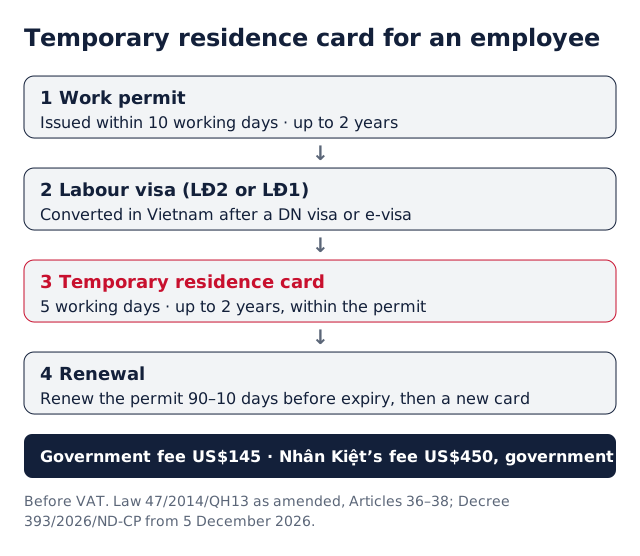
| Stage | Time | Who acts |
|---|---|---|
| Work permit | Up to 10 working days | Provincial People’s Committee |
| Labour visa or visa conversion | About 5 working days | Immigration authority |
| Temporary residence card | 5 working days | Immigration authority |
| New card at renewal | After the work permit is renewed | Employer as sponsor |
Cost
How much does a Vietnam temporary residence card cost?
A Vietnam temporary residence card costs a government fee of US$145 for a card of up to 2 years, under Circular 25/2021/TT-BTC as amended. Nhân Kiệt files the card for your entity for US$450, government fee included, plus VAT.
| Card term | Typical holder | Government fee |
|---|---|---|
| Up to 2 years | Employees (LĐ1, LĐ2) | US$145 |
| Over 2 to 5 years | Investors (ĐT2) | US$155 |
| Over 5 to 10 years | Investors (ĐT1) | US$165 |
| Service | When | Fee |
|---|---|---|
| Work permit | Before the start date | US$650 |
| Temporary residence card | After the work permit | US$450 |
| Business visa | Only if needed to enter first | US$250 |
| PEO payroll and HR | Every month | US$35 |
Worked example: a new foreign manager needs a work permit and a residence card, so the one-off cost is US$650 + US$450 = US$1,100 before VAT. Running payroll and HR for that manager under a PEO costs US$35 a month, or US$420 a year.
To get a quote, send the employee’s nationality, the province, the visa they hold now and the planned start date through the quote form or on WhatsApp or Zalo at +84 908 636 108.
Card or visa
Temporary residence card or visa: what is the difference in Vietnam?
In Vietnam a visa lets a foreign national enter for one purpose and up to 2 years, while a temporary residence card replaces the visa for long stays and allows unlimited exits and re-entries. An employee with a 2-year work permit is better served by a card than by repeated visas.
| Point | Labour visa (LĐ2) | Temporary residence card |
|---|---|---|
| Longest term | 2 years | 2 years for employees, 10 years for ĐT1 investors |
| Form | Passport stamp or sticker | Separate ID card |
| Exits and re-entries | Single or multiple, as issued | Unlimited while valid |
| Government fee | US$145 for a 1–2-year multiple-entry visa | US$145 for up to 2 years |
| Proof of residence | Shows the purpose of entry only | Shows the right to reside for the card term |
Common mistakes
Which mistakes delay a Vietnam temporary residence card?
These are the mistakes Nhân Kiệt sees most often when employers apply for a temporary residence card in Vietnam:
| Mistake | Consequence | Check |
|---|---|---|
| Applying on a DN1, DN2 or e-visa | Not eligible; dossier returned | Get the work permit, then convert to an LĐ visa |
| Asking for a card longer than the work permit | Card cut to the permit term or dossier returned | Match the card to the permit end date |
| Passport expiring too soon | Shorter card, or a new passport needed first | Passport valid 30 days beyond the card |
| No temporary residence registration | Dossier incomplete; fine for the host | Register the address with the local police |
| Keeping the card after changing employer | The card no longer matches the sponsor | New permit and new card under the new employer |
Work-permit rules from 5 December 2026 are in the Vietnam work permit guide.
Questions
Vietnam temporary residence card: frequently asked questions
How long is a Vietnam temporary residence card valid for an employee?
Up to 2 years for an LĐ1 or LĐ2 holder, and never longer than the work permit or exemption it is based on.
How much does a temporary residence card cost in Vietnam?
The government fee is US$145 for up to 2 years. Nhân Kiệt’s fee is US$450 per card, government fee included, plus VAT.
How long does a temporary residence card take in Vietnam?
5 working days from a complete dossier, under Article 37 of Law 47/2014/QH13. The work permit and labour visa must come first.
Can a DN1 visa holder get a temporary residence card in Vietnam?
No. DN1 and DN2 business visas do not qualify. The employee first needs a work permit, then an LĐ2 visa, then the card.
Who issues temporary residence cards in Vietnam?
The Immigration Department of the Ministry of Public Security, or the immigration office of the provincial police where the sponsor is based.
Who sponsors a temporary residence card in Vietnam?
The Vietnamese company the foreign national works for, the same company named on the work permit.
Can a temporary residence card in Vietnam be extended?
No. When it expires, a new card is issued. For an employee that follows the work-permit renewal, filed 90 to 10 days before the permit expires.
Can the family of a foreign employee get a temporary residence card in Vietnam?
Yes. A spouse and children under 18 can get a TT card, valid no longer than the employee’s own card.
Does a temporary residence card holder need a visa to re-enter Vietnam?
No. A valid card allows unlimited exits and re-entries until it expires.
What happens to the card when the employee leaves the company?
The card is tied to the sponsor. A new employer must obtain a new work permit and sponsor a new card.
Sources
Sources and review.
This guide is based on these primary sources:
- Law 47/2014/QH13 on the entry, exit, transit and residence of foreigners, as amended by Law 51/2019/QH14 and Law 23/2023/QH15
- Circular 25/2021/TT-BTC on visa and residence fees, as amended
- Decree 393/2026/ND-CP on foreign workers, from 5 December 2026

Written by Nguyễn Quốc Trung, Deputy General Director of Nhân Kiệt, and checked by Nhân Kiệt’s payroll and employment-law team against the legal texts and the payroll Nhân Kiệt runs for its employees every month. Nhân Kiệt holds labour-leasing licence 029/LĐTBXH-GP and has employed people in Vietnam since 2009. To report an error, email info@eorvietnam.vn; see how these guides are written and checked.
Hiring in Vietnam? We employ your team for you.
Nhân Kiệt employs your team and runs payroll, insurance and tax. EOR fee: US$99–199 per employee a month, plus VAT.
Request a quote